Writing & Thought Leadership
Beyond the Unemployment Rate: The Displacement of Black Women at Work
By Kesha T. Ward, PhD
What the 600,000 Figure Actually Measures
Let’s start with the number: 600,000. In 2025, news reports and social-media posts widely described this figure as the number of Black women pushed out of the workforce. It was repeated across headlines until it hardened into a fact circulating widely across social media. The problem is that the figure does not represent 600,000 in documented layoffs, nor does it represent 600,000 women. The number was constructed by combining a decline in employment with the number of women who remained unemployed and those who left the labor force. Those categories are not mutually exclusive. A woman who lost her job and decided to stop looking for employment may be counted in more than one measure. This is not to say that the number is fabricated; it does reflect a real and disturbing deterioration in Black women’s labor market position.
Revised federal data tells a more realistic story. Black women experienced a steep decline in employment during 2025 and absorbed a disproportionate share of job losses when compared against the American workforce. That distinction matters because the displacement of this demographic of workers is larger and more complicated than what a simplistic layoff count could reasonably capture. The number includes the Black women whose federal positions were eliminated in a single round of cuts. It also includes professionals whose work hours have been reduced or responsibilities diminished without a formal termination. The reality is that no single figure captures the diverse experiences of Black women in just one number.
Although methodologically imperfect, the 600,000 figure may be appropriately used to describe the various ways Black women became disconnected from stable employment. Treating it as a precise body count invites dismissal the moment someone checks the math, and the important piece of the story gets discredited. The more defensible claim is much more narrow yet still disturbing; Black women lost employment at a rate sharply out of proportion to their share of the labor market, and the instruments commonly used to track job loss were not designed to capture the full shape of the phenomenon.
What the Data Actually Show
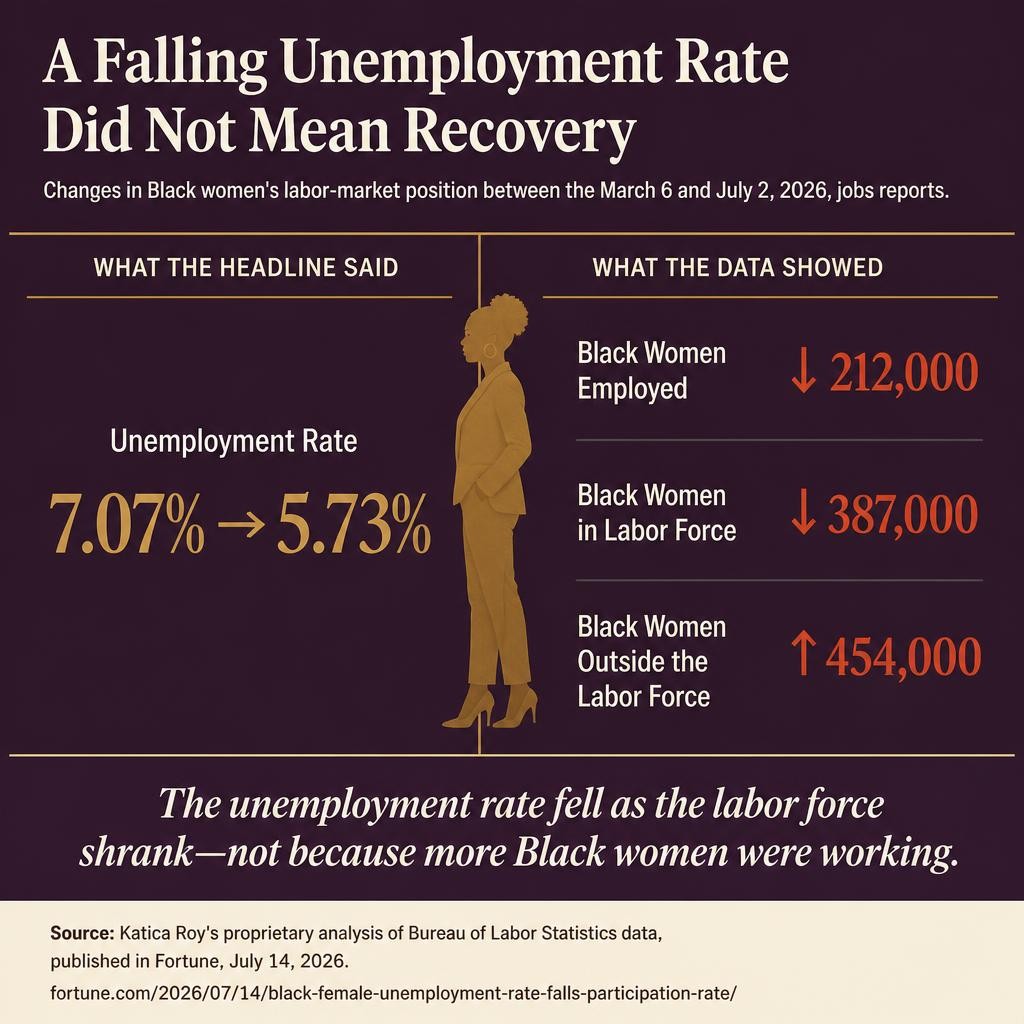
An analysis of Bureau of Labor Statistics data published in Fortune found that Black women’s unemployment rate fell from 7.07 percent to 5.73 percent between the March 6 and July 2, 2026, jobs reports. This is a shift that on the surface, tells a story of recovery yet, when examined closely, the reverse appears to have occurred. Analysis of the same reporting period revealed that employment among Black women actually fell by 212,000 even as their working-age population grew by 67,000. Their labor force shrank by 387,000, and the number of Black women no longer counted as active in the labor market rose by 454,000. Clearly, a falling unemployment rate coupled with a shrinking labor force is bad news. It is a sign that many of these workers were no longer being counted as unemployed, not that they successfully re-entered the labor force.
The pattern of Black women exiting the labor force was visible across the prior calendar year. The Economic Policy Institute found that Black women’s labor force participation dropped from a high of 60.6 percent in 2024 to 59.7 percent in 2025, while their unemployment rate rose from 5.8 percent to 6.7 percent over the same period. The sharpest decline was among the most qualified and credentialed. Black women with a bachelor’s degree saw their employment-to-population ratio fall by 3.5 percentage points. This was a steeper drop than that experienced by any other educational category, including workers without a college degree.
The longer the hunt for work lasts, the greater the damage, which is something that unemployment rates alone cannot capture. Women displaced from senior or specialized roles are finding that their job search can stretch for longer than a year, particularly when the role does not have an equivalent in the consulting space. A woman who spent fifteen years building expertise in a field is not easily reabsorbed elsewhere. The longer the search runs, the more likely she is to eventually exit the market altogether rather than remain classified as unemployed.
Why Black Women Were Especially Exposed
Black women were vulnerable to the recent job market contraction because they are disproportionately represented in public sector employment. Government work has historically provided Black women with a more reliable path for converting educational attainment into stable employment. Merit-based civil service systems have never been free from racial discrimination, but they limited some of the unchecked discrimination that has historically disadvantaged Black applicants in private industry hiring.
The federal workforce illustrates the scale of Black women’s exposure to public-sector contraction. In fiscal year 2020, Black women accounted for 11.7 percent of civilian federal employees, which was nearly twice their 6.6 percent representation in the civilian labor force, according to the U.S. Equal Employment Opportunity Commission. In October 2025 alone, federal employment fell by 179,000 jobs, bringing the workforce to its lowest since July 2014. The job losses in that period collided with state and local budget pressures, including a broader retreat from diversity, equity, and inclusion (DEI) work that had ramped up in the private sector before Donald Trump returned to the White House.
When a sector experiences contraction that has historically functioned as a refuge from private-sector discrimination, the workers most concentrated in that sector oftentimes do not have an equivalent role elsewhere. The retreat from DEI commitments compounds this, because many of those roles were disproportionately held by Black women who were recruited because organizations wanted visible evidence of DEI in action. When budgets tighten, those roles are often first to be cut because they never possessed the structural protection that core business functions have.
Why Finding the Next Job Is So Difficult
Reentry into the workforce is not straightforward. Black women searching for employment face hiring discrimination that operates on both race and gender simultaneously. Resume audit studies have found that even with identical qualifications, fewer callbacks are made when the applicant’s name signals they are a Black woman. Credentials that would open doors for other candidates get discounted, and degrees from historically Black colleges and universities are minimized in ways that degrees from predominantly White institutions are not. Network access can be just as powerful as credentials. Much of hiring particularly in roles above the entry-level happens through referrals and informal recommendations. Black women may have less access to the networks where those referrals circulate. When a generally weak job market is layered on to these barriers, the result is a search that can drag on well past what savings and patience can sustain.
Why Leaving the Labor Force Matters
Eventually, many women stop looking for work, and that decision is explained statistically as if it were solely a personal choice. The decision to abandon a stressful and demoralizing job search is not solely a personal choice. Discouragement after months of rejection is a rational response to a job market that keeps saying no. Once a woman is no longer actively searching, she disappears from the calculated unemployment rate entirely. This is precisely why that rate can appear to fall while the underlying unemployment crisis deepens.
What replaces active job searching is rarely leisure. It is financial pressure that forces a set of alternatives: early retirement drawn years before planned, self-employment out of necessity, and gig work taken even though it pays a fraction of previous income. Black women already own an estimated 2.9 million businesses, which is roughly eighteen percent of all women-owned companies in America. This business ownership does not necessarily provide economic security. According to the 2026 Wells Fargo Impact of Women-Owned Businesses research, Black women-owned businesses generated an average of $41,000 in revenue in 2025, compared with $179,000 across women-owned business overall. This is not a criticism of the business owners. Instead, it reflects the persistent barriers to start-up capital and professional networks that help businesses scale. These alternatives for employment do not mean the original displacement has been resolved. The displacement has been redistributed into categories that conventional employment statistics treat as distinct outcomes and not connected consequences of job loss. Black women do not disappear from the job economy when they no longer appear in unemployment data because what happens to them is much harder to see.
Conclusion
Historically and statistically, Black women have functioned as a bellwether for the broader labor market. Downturns in employment tend to impact them first, and recoveries reach them last. What is happening now is not an anomaly; it is a pattern operating at a scale so severe that it cannot be ignored. The instinct to read Black women’s unemployment as an individual failure or a story about resilience is a miscalculation. Systems produce outcomes, and when a system consistently produces the same outcome for the same group of workers, yet it gets folded into unemployment numbers, it paints an incomplete picture.